

Designing Modern Homes in Toronto:
A Residential Architect’s Perspective
On craft, conviction, and twenty years of modern residential architecture in Toronto.
We have been designing homes in Toronto for over twenty years. In that time, the city has changed, the conversations around modern architecture have shifted, and the clients we work with have become more sophisticated in how they think about the spaces they live in. What has not changed is our approach: every project begins with the land, moves through the life of the people who will inhabit it, and arrives at a building that could not have existed anywhere else, or for anyone else.
We are FrankFranco Architects, a Toronto-based residential architect studio founded by Francesco DiSarra. Our work sits at the intersection of modernist discipline and customization. We do not apply a signature aesthetic uniformly to every project. We have a methodology—and that is a different thing entirely.
The Fortified Front:
Privacy as Architecture
Walk up to one of our homes and you will notice something unusual: you are not immediately sure where to go in. This is intentional.
We try not to make the front entrance so apparent. We try to make it more reclusive. The front of the home, the public face, the street-side facade is treated as a boundary, not a welcome mat. It is fortified, quiet, and controlled. You must make a deliberate move to enter. And once you do, the home opens.
There is a clear narrative written into the architecture: enter here, move this way, ascend the stairs, and then the main floor opens to you. Space is revealed sequentially, and deliberately. The experience of the home is choreographed. We want to control what you see, and when you see it because the reveal is part of what gives a home a sense of generosity, not just scale.
Designing for the Site,
Not for the Portfolio
As residential architects, one of the most important decisions we make is where and how to place a building on the land. For us, the site is never a constraint to work around, it is the starting point.
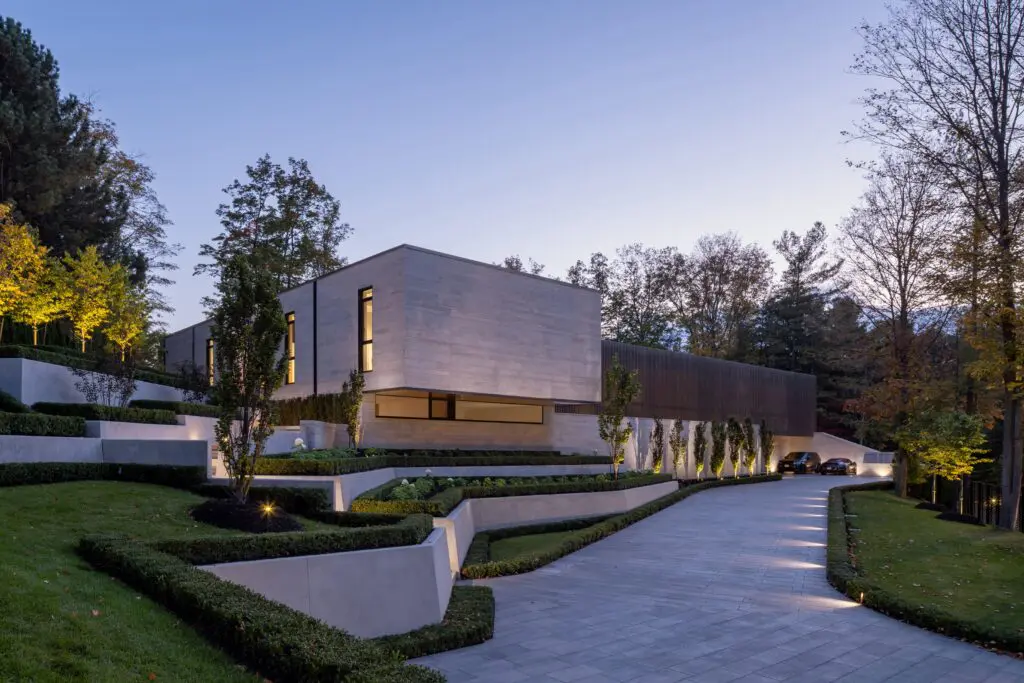
Our Clubhouse residence is one of the clearest examples of this thinking. Perched on a reverse-sloping lot north of Toronto, overlooking the National Golf Club of Canada, the project presented a site challenge that inspired the design. The lot sloped away from the road, the back higher than the front, which meant a conventional approach to the garage, driveway, and ground floor entry would have produced something awkward. So we built the design around the land’s logic instead.
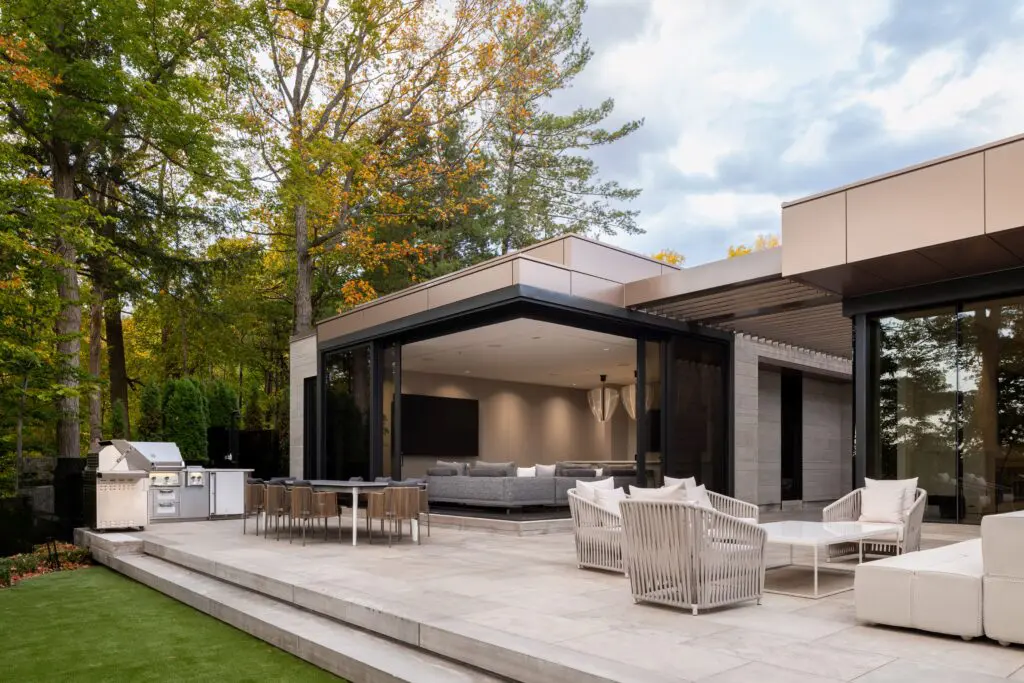
The design became intertwined with addressing the lot. It was a hierarchy of decisions. The garage moved to a lower level. The driveway grade was kept sensible. The view at the back (the reason the site was chosen) was preserved and framed. Inspired in part by Ludwig Mies van der Rohe and Lilly Reich’s Barcelona Pavilion, Clubhouse uses expansive glass, thin walls, and disciplined design, to reinterpret opulence in a quieter way. It is the first home you see when entering the estate community, and it reads differently from everything around it, not because it is trying to, but because it is the product of genuine thinking rather than stylistic borrowing.
While our Toronto projects focus on urban context and privacy, these same principles of site-specific placement are vital when creating modern cottages that must harmonize with the rugged terrain of Ontario’s cottage country.
Material Discipline and the Art of the Uncut Stone
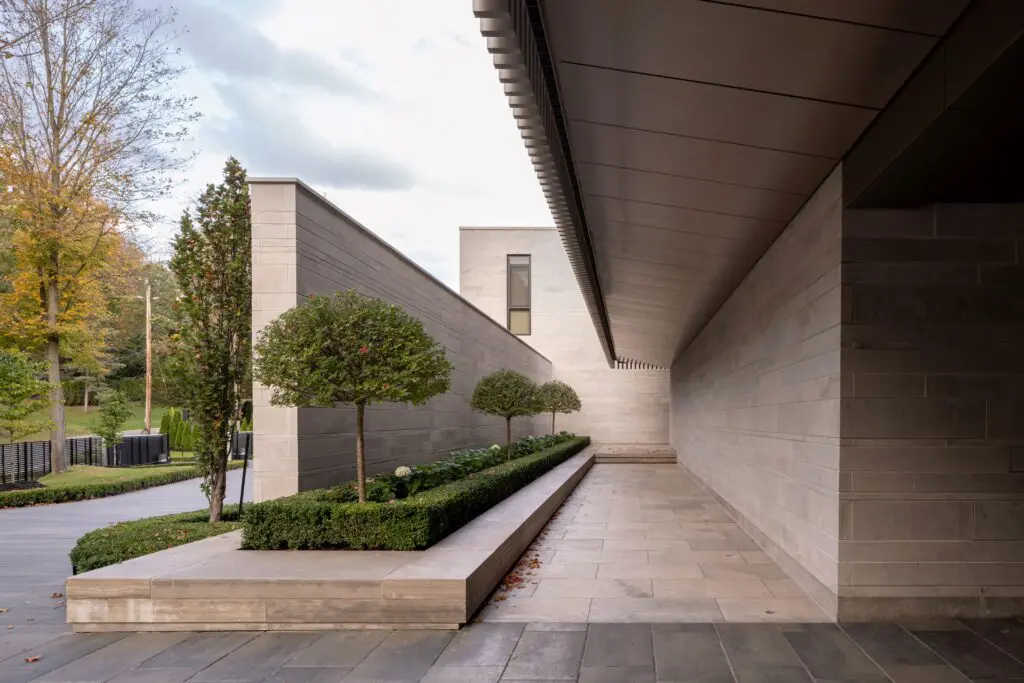
One of the markers of our exteriors is restraint. We work with very few materials on any given project, and we use them with a rigour that is rarely visible to the casual eye.
On Clubhouse, this took the form of a stone cladding exercise we set for ourselves: how do we clad this house in stone at the top and bottom of every window without cutting a single piece? Without showing a single cut?
The answer required calculating every row, designing custom hidden courses within the cladding, and treating the entire facade as a puzzle whose solution would be invisible to most people but would register, nonetheless, as something pure. When you see it, not everybody understands exactly what they are looking at, but it adds to the contemporariness of the architecture. It fortifies and strengthens the idea of form. That is a self-imposed problem. It serves no structural function. It answers an idea. And the tradespeople who built it often pushed the concept further than we had initially asked, which is the best possible outcome.
Rome, the Oculus, and the Long View of Influence
Our founder, and principal architect, Francesco DiSarra, studied abroad in Rome, an experience that shaped the way we look at buildings as a team. Rome is a city that has been reinvented many times over. Materials are repurposed. Structures are folded into new contexts. Everything bears the marks of its own history.
When you are given the opportunity to peel back the veil of time and see how they did things, you can study these choices with open eyes and carry the lessons into the future. While studying in Rome, the Pantheon was Francesco’s daily meeting place with his professor. That image of the sky pulled into the heart of the building, never left him. For us, that shows up in the use of structure as expression, the careful shaping of material, and what we call the oculus—a vertical element that appears in many of our projects, connecting interior space to the sky above and the landscape below. It is about integration: how the architecture and the exterior world speak to each other.
For those seeking Toronto modern homes that carry this kind of intellectual weight, where design decisions trace back through decades of study and precedent, we believe our body of work offers something the market rarely produces at this scale: architecture that thinks.

A Modern Home Is a Canvas. Not a Prescription.
There is a persistent misconception about modern residential architecture: that it is cold, austere, without warmth or personality. Flat roofs. Minimal cladding. Empty rooms. We have heard it often enough to have a considered response.
A modern home is a canvas. It is a canvas for you to inhabit, a canvas for you to fill with your life. It is not a canvas of dictation. Our job is to keep it quiet, keep it simple, and address the way you actually live. The wants are what you bring to it: how you arrange your furniture, how you move through the space, the art on the walls, the views you choose to frame. We create the conditions. You complete the picture.
This is a more demanding kind of design than it might appear. It requires us to understand not just what clients say they want, but how they actually live. We slow that conversation down. When clients arrive with folders of inspiration images, we ask them to set them aside for a moment, and talk to us about their home, how they live, and to show us three things they truly love. Not fourty, three. From there we take cues, and then we try to give them something they have not seen before.
Every home we design is a one-off. What follows is a process of translation—from a way of living into a sequence of spaces, volumes calibrated to actual use, rooms sized to real activity. The mudroom a young athletic family actually needs. The kitchen a serious cook can actually work in. The view that this particular site, and no other, makes possible.
Award-Winning Work,
Built on Trust
We received the Architizer A+ Awards People’s Choice Award for Best X-Small Firm, and the Archello Best Small Firm Award–both recognized by a public vote. That recognition meant a great deal to us, precisely because of who cast the votes. Average people, homeowners, people with no particular reason to care about architectural theory, they voted. They voted for the design.
For a studio whose work lives in the real world, in the homes of real families across Toronto and its surroundings, that kind of acknowledgment lands differently than a peer award. It suggests the work communicates beyond the discipline. That the ideas are legible.
As award-winning residential architects working in this city, we occupy a specific position among Toronto’s top architecture firms. Not the loudest. Not the largest. But among the most deliberate, and among those most likely to hand you something you have not seen before.
Every Building Gets Sold. Every Design Remains.
Clients move on, ownership shifts, neighbourhoods evolve. But the architecture endures, and with it, the ideas embedded in its walls, its thresholds, its uncut stone.
Every home will one day belong to someone new. Still, we can knock on the door and say we designed it. In that sense, it is always ours–a responsibility we don’t take lightly, and the through-line of everything we have built over the past twenty years.
We believe in designing homes that outlast trends and ownership. Even as homes change hands, the architectural ideas behind them remain, and we take lasting pride in the work we create.
Work With Us
We are a Toronto-based residential architect studio with over twenty years of experience designing modern homes across the city and its surroundings. We are known for site-specific design, material discipline, and a client process built on genuine listening. We take on a limited number of projects each year, the kind of constraint that keeps the work honest.
If you are exploring a residential build or renovation and want to work with a team that will bring considered design to your project, we would like to hear about it.